| |
|
|
| Art & Architecture |
| Collection Robert Lebel: Old Master and 19th-century Drawings , Sotheby's Paris, Auction, March 25, 2009 (Click here for Illustrations.) |
| Michael Miller |
March 27, 2009 |
Whenever a work of art changes hands there is always a story behind it. When a collection appears on the market an entire lifetime emerges, or, in the case of figures like Robert Lebel (), a chapter in history. In the catalogue to the sale of his old master drawings, Sotheby's manages to condense Lebel's extraordinary range of interests and experience into a single paragraph. To say that he "defied classification" is not an exaggeration. An art historian and collector, he wrote essays, novels, as well as the first biography of Marcel Duchamp. He was a friend of André Breton, Max Ernst, and Jacques Lacan. During the Second World War the circle went into exile in New York, where Matta, Tanguy, and Claude Lévi-Strauss joined them. At this time Lebel acquired as special interest in American Indian art, especially Eskimo art. His pioneering collection of Eskimo masks was sold at the Hôtel Drouot in 2006. Now Sotheby's has dispersed his important collection of old master and 19th-century drawings.  |
|
|
at the Williams College Museum of Art
November 14, 2008âMay 17, 2009
See also:
LEWITT I: Sol LeWitt: A Wall Drawing Retrospective
LEWITT II: Sol LeWitt: A Wall Drawing Retrospective
|
| Richard Harrington |
March 13, 2009 |
|
This exhibition at is supplemental to the immense retrospective installation at MassMoca in North Adams. In some surprising ways it reveals more of the evidentiary by-products of the thought process of the seminal conceptual artist than the spectacular realizations at MassMoca.Â
Thereâs only one artifact that has any color in the exhibition, a systematic gridded display of clouds, the rest of the installations are in black-and-white or achromatic gray. The spare simple constructions in the exhibition which are executed cleanly and in an intimate or intermediately large scale seem to reveal more of the presence of the artist (if not his hand) than the murals and wall drawings at Mass Moca.
|
|
|
Museum of Modern Art, New York, March 1 - May 11, 2009
|
| Huntley Dent |
March 16, 2009 |
| Pretty funny guy, for a German. The curators who put together the current large retrospective of Martin Kippenberger, knowing that his name will be new to almost every visitor, have emphasized that he's funny. Or, to use their choice of words, hilarious, absurd, all over the map. Without prompting, I doubt that many viewers would think so. Early in his career, which began around 1971, Kippenberger coated a Ford Capri in brown paint mixed with straw and oatmeal. We are told that this is a humorous comment on Anselm Kiefer, the prominent German painter who famously coated the surface of his canvases with straw. Okay. Next to the Capri on the museum floor sits a waist-high wooden box, painted the same dun brown with straw and oatmeal, that Kippenberger dubs an orgone boxâin reference to Wilhelm Reich's infamous contraption that was supposed to trap free-floating sexual energy. Through the half-open door of the box we glimpse some early, rejected canvases of Kippenberger's, placed there, he tells us, so that they can acquire fresh energy and become acceptable. Not a lot of laughing was going on around me. |
|
| Joanna Gabler, Kreutzer Series: Gallery |
| Michael Miller |
March 10, 2009 |
|
After hearing Ani Kavafian and Mihae Lee's recital of September 25, 2008 in Chapin Hall (reviewed here), Joanna Gabler felt inspired, especially by their playing of Beethoven's "Kreutzer" Sonata. She went to her studio after the concert and began a series of mixed media drawings which recreate the impression the Ms Kavafian and Ms Lee's playing of the sonata made on her that evening. The works, which involve a complex monoprint-like process created with water-soluble oils enriched by pen, pencil, and pastel overdrawings on layers of a very thin, semi-transparent paper and superimposed on a white background with an archival matte acrylic medium, took some time to complete, but they capture the immediacy of her experience in the concert hall.
All nine works are currently on view in Joanna Gabler's exhibition, Painting Music and More, in in Williamstown, which will remain so until March 31. Her digital images from nature are concurrently on view at the in North Adams as part of an exhibition of three woman artists in which Anita Rydygier from Canada is also showing her gouache and ink drawings and Rieko Fujinami from Japan is showing her Film Drawings and Fresco Seccos. |
|
|
Museum of Modern Art, New York
December 14, 2008âFebruary 16, 2009
|
| Huntley Dent |
March 13, 2009 |
| Atrociously hip? I defy anyone to take in the works of Dutch painter Marlene Dumas at one go. We are decades past Ezra Pound's "Make it new" and Diaghilev's âÃtonne moi," but there's no escaping both injunctions, to the point that an artist may invite cynicism when turning to corpses with slit throats and little girls hanging from nooses as her subjects. Dumas doesn't dare to repel. It's her whole shtick. Painting after painting, almost all portraits and figures, dwells on the horrific and spiritually numb. There's a series of blobby alien babies with hydrocephalic heads and bowed legs. These look uniformly anguished and perhaps mentally defective. There are prostitutes and suicides and the afore-mentioned corpses painted on slabs in the morgue. By the time you arrive at her "Homage to Rembrandt's Woman Pissing," an ink drawing depicting a squatting peasant spraying a black jet of urine like a faucet, it's hard not to become inured to so much ghastliness. |
|
|
| Michael Miller |
January 21, 2009 |
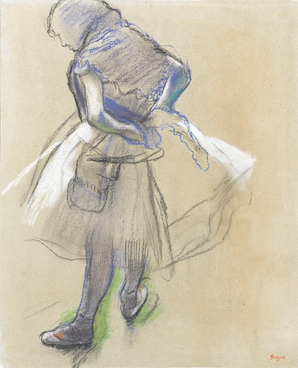
| As the world economy began to unravel in September and October, the art market continued to prosper for a week or two before entering a volatile phase which has generally been hard on the major auction houses and dealers. However, the most important and desirable objects continued to sell at prices one would have expected before the collapse. "Suprematist Composition" by Kazimir Malevich sold at Sotheby's New York on Nov. 3 for $60 million. A superb Degas dancer fetched $37 millionâa record for a work on paper; and The blue Wittelsbach diamond sold for over $24 million at Christie's London on December 10th. Souren Melikian, explained the phenomenon well.Buyers were driven by the awareness that these works are unique. Moreover, these areas of the market were not much affected by the consumerist bubble which characterized the contemporary art market, as nouveaux riches fell over one another acquiring bigger, gaudier, and nastier trophies for their oversized homes. As Melikian said, connoisseurs had an opportunity to "take back control of the art market." |
|
|
Jan. 28,
Jan. 29 - 30,
Jan. 31,
Jan. 27,
Jan. 28,
Jan, 29,
Jan. 30,
For more background on master drawings, see
|
| Michael Miller |
January 27, 2009 |
| Although, as I pointed out in my preview of the dealer shows, the old master market was less affected by the notorious bubble than contemporary art, there is no question that here too a period is coming to an end, which means of course that a new one will begin at some point. We don't know when or what it will be like. Why not now? There are certainly splendid opportunities both with dealers and with the auction houses. In general prices are moderate, and the quality is very high. What's more there is an abundance which he have not seen for some years, nothing like pre-1995, and certainly not a glut, but enough to be exciting. Ultimately this is an excellent time to buy art, whether a collector is progressing in a direction he or she has already begun, is expanding into new areas, or is at the very beginning of the glorious enterprise. |
|
|
LEWITT II:
Sol LeWitt: A Wall Drawing Retrospective
A collaboration between Yale University Art Gallery, MASS MoCA, and the Williams College Museum of Art
Mass MoCA, North Adams, MA; 11:00 a.m.â5:00 p.m. closed Tuesday and Christmas:
See also:
LEWITT I: Sol LeWitt: A Wall Drawing Retrospective
LEWITT III: The ABCDs of Sol Lewitt
|
| Richard Harrington |
December 11, 2008 |
|
With the chronological retrospective exhibition of the wall drawings of Sol Lewitt, Mass MoCA has duly taken its place on the stage as a magnet for contemporary art.
Â
Mr. Lewitt was one of the core group of New Yorkâs Minimal art movement that included Donald Judd, Frank Stella, Kenneth Noland and others.
âThe will to a system is a lack of integrityâ
Friedrich Nietzsche
This observation, which was a central axiom of Abstract Expressionism, doesnât account for the fact that the material realization of any artwork is intrinsically programmaticâbe it an Altamira cave painting or a Bach fugue.
|
|
|
Sterling and Francine Clark Art Institute, Williamstown
October 12, 2008 - January 4, 2009
|
| Michael Miller |
December 1, 2008 |
| As the supply of old master drawings on the market dwindles, so do exhibitions of them, but if the exhibitions are fewer, their quality remains almost as strong as ever. The Uffizi continued its distinguished tradition at the Morgan Library this past winter, and now the Clark offers a fascinating and very beautiful layered exhibition consisting of sheets from different periods in the formation of its own collection interleaved with one of the most original and appealing of present-day private collections, the Italian drawings of Robert Loper, whose gifts include, in addition to expertise in the nooks and byways of Italian art of the sixteenth through the eighteenth century, fine taste, and a keen sense of fun. |
|
|
LEWITT I:
Sol LeWitt: A Wall Drawing Retrospective
A collaboration between Yale University Art Gallery, MASS MoCA, and the Williams College Museum of Art
See also:
LEWITT II: Sol LeWitt: A Wall Drawing Retrospective
LEWITT III: The ABCDs of Sol Lewitt
|
| Michael Miller |
November 18, 2008 |
| This is intended as no more than a preliminary reflection on the retrospective installations which just opened at Mass MoCA and the Williams College Museum of Artâa first impression gathered when the galleries were full of people, some of whom I see all the time and others not in years. Amidst all the champagne, the personalities, and the excitement, the wall drawings still made their presence felt, rather powerfully, I thought. His measured forms and resonating colors were able to make their Platonic statement above all that mundane human static. |
|
Béla Julesz,  Cambridge, Massachusetts, 1995, 2006, MIT Press Cambridge, Massachusetts, 1995, 2006, MIT Press |
| Richard Harrington |
September 25, 2008 |
|
âA stereo image is worth two thousand words.â âBéla Julesz
was written by Dr. Béla Julesz (), a pioneering researcher in vision and perceptual psychology. The book would be ever-so-slightly dated, if that âevaluationâ were to be made on some type of a Kurzweilian data table, where time is judged on a steeply exponential basis. But given the scope and breadth of references in this book, which span three hundred-or-so years, it remains a compelling, highly insightful time capsule.
It is written by an author with binocularly ironic eyesâand bifurcated witâas a series of dialogues with âB,â his skeptical fictitious alter-ego, about the subject of cognition in humans and peripheral themes relating to visual sensory information gathering.
|
|
|
| Huntley Dent |
August 30, 2008 |
| Lashed to the mast. Having missed the Turners at the Tate, I visited them on tour at the Metropolitan Museum in New York after crossing the Atlantic. To assuage feelings of lost pleasure on leaving London, the Met show, simply named J.M.W. Tuner, proved to be a spectacle even the Tate doesnât manage. In fact, the Tate gives a skewed view of their coveted prize pet (they and the National Gallery own the bulk of his surviving work) by covering their walls with only oil paintings. Great as these are, one wouldnât grasp that Turner left behind, besides over 500 oils, almost 2,000 watercolors, thousands more prints, and myriad working sketches at every stage of inspiration. At the Met show we get two dozen âcolor beginnings,â as Turner dubbed his sketches, for a finished oil, The Burning of the Houses of Parliament, with Westminster Bridge. Itâs part of Turnerâs legend that he breathlessly painted the disaster first hand when Parliament burned out of control for seven hours in the fall of 1834, but in reality the final images required many try-outs before he was satisfied. |
|
| B. F. Kiefrich, Spam Artist, Remembered |
| Michael Miller |
September 1, 2008 |
| You may wonder about my interest in this traditional American delicacy. It comes not from the interests I share with Sgr. Rossini, but from my experiences as a curator in the Cleveland Museum of Art. As my colleagues and I pushed papers and watched Western civilization melt into Lake Erie, a remarkable artist from Akron came to our attention. This artist, who worked under the name B. F. Kiefrich, produced sculptures from Spam®, among them an exquisite gilt miniature Book of Hours, known as the Codex Spambergensis and a porcine version of Nefertitiâs lips. Since Kiefrich emerged at the height of post-modernism, the referential character of his work should not be surprising. Suddenly, just as he was about to achieve world fame, he disappeared. Spam® sculpture has since been (rather, vulgarized)âto its detriment. No Spam®artist has ever shown the genius of Kiefrich, with his medievalistâs sensibility and devotion to the painstaking craft of the miniaturist. |
|
| A Visit to the Rembrandtshuis |
| Huntley Dent |
August 9, 2008 |
| Rembrandt at home. A lifelong love of Rembrandt compelled me to join the crowds for a look at Rembrandtâs house in Amsterdam. One quickly becomes aware that the city still belongs to Rembrandt in a way that London doesnât belong to Shakespeare. The geometrically neat streets and lazy green canals are little changed from the golden age of the 17th century. As late as the mid-Victorian era the first neighbourhood where Shakespeare lived in London, Bishopsgate, remained standing and can be viewed in crumbling salt prints (the locale was wiped out with the arrival of the railroad). But the spectral sensation of standing in the courtyard of a galleried inn where the young Shakespeare stood is no longer ours. By contrast, you can touch the props that Rembrandt stored in his upper rooms (plumes, plaster busts, armor, spears, and other oddments that he turned into exquisite ornamentation) and squeeze up the winding spiral stairs that join the floors of a typically narrow, elongated house, the kind that line Amsterdam like brick books on a shelf. You can gawk at oak cupboards that open up to disclose the feather beds tucked inside that appear too small for even an undersized man. Much of the site known as the Museum Rembrandtshuis is not original, having been restored and hoked up as in Henry Jamesâs disillusioned short story, âThe Birthplace.â The difference is that on one floor of the adjacent new house that parallels the old one, an exhibit of Rembrandtâs etchings delivers much more than the experience of stage-managed atmosphere and vacated ghosts. |
|
| A Visit to the Tate Modern |
| Huntley Dent |
July 9, 2008 |
| Oh, that this rain would end! I dried my socks by stepping into the Tate Britain this afternoon. The museum collection is divided into three parts â the glorious, the dull, and the querulous. The glorious, all those luminescent Turner paintings, went on tour this year, so the mobs arenât in attendance. The management left a few strays lingering in various galleries (like the sublimely bucolic Golden Bough and a Venetian water scene where only an outlined gondola betrays that Turner wasnât painting a celestial city), and these left-behinds glow like yellow sapphires. The dull part of the Tate consists of traditional British paintings, large rooms hung double-decker style with portraits of horse-faced lords and their pale, powdered ladies. I have to squint to read the labels, so itâs work to separate the Reynolds, Gainsboroughs, and Van Dycks from the acreage of peerage that surrounds them. If I sound captious, itâs because the third portion of the Tate Britain, devoted to modern art, exasperated me. |
|
| Rockwell Kent and the Cape Cinema Mural |
| Lucy Vivante |
July 5, 2008 |
| Part of the appeal comes from the high contrast between outside and in. The church-like exterior is patterned after the nearby town of Centerville's Congregational Church. The murals you might expect insideâof a Puritan religious gathering or colonists workingâare instead of exuberant figures dancing across the ceiling. Within the space of a few feet, just by crossing the lobby, we travel from stern New England to lush Art Deco. |
|
| Hoosac River Lights, April 26, 2008 |
| Photo Gallery by Joanna Gabler and Michael Miller |
May 22, 2008 |
Ralph Brill, of the initiated the - an outdoor artistic lighting project that drew crowds of thousands to its Inaugural Event on the evening of April 26, 2008. The Hoosac River Lights Project celebrated the Hoosac River and brought it back into people's consciousness. Over time it might become an annual City of North Adams Event lasting several days. Once a dynamic river that powered the old textile and shoe mills in the region the Hoosac was placed in a concrete channel in the 1950s to prevent costly flood damages. Today, the Hoosac River remains largely unnoticed as it winds its way through the center of North Adams. |
|
| Joanna Gabler, painter, Nature Transfigured, at the Latchis Theater, Brattleboro...and Ancient Greece |
| Michael Miller |
December 20, 2007 |
| In December the Latchis Theater in Brattleboro will be showing recent abstract works by . This selection of paintings has its origin in Nature, and her reflection in Joanna's spiritual life.Â
In her mediative art Gabler strives to present the magical and transformational realm of invisible energies which form nature and whole universe around us. Though invisible to unprepared eyes, these forces or currents of energy are experience by everybody and influence very deeply our emotions, feeling and thinking. Using Joanna's work as a gateway we can enter into the realm of the forces within the nature to understand ourselves, our relation to them, our place in the world and to realize that the forces outside us are the same energies which work in our bodies and psyche. We come back from that that journey enriched, with a deeper understanding that there is only one world and that we are one with it.
|
|
|
|
| Edgar Degas, A Standing Dancer, Her Hands Behind her Back, Stephen Ongpin Fine Arts, Master Drawings, New York |
|
|
| |
| Search The Berkshire Review for the Arts |
|
|
| |
|
|
|
|
|
|