|
|
|
|
|
Photography
|
|
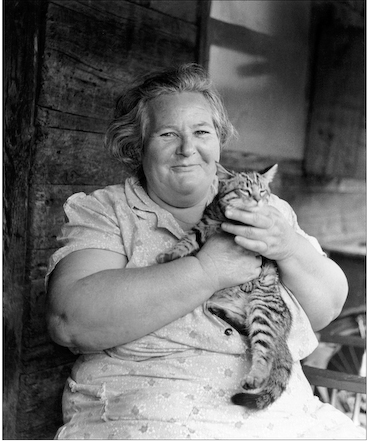
Almost Utopia: The Residents and Radicals of Pikes Falls, Vermont, 1950, photographs by exhibition at the with photographs by Rebecca Lepkoff, text by Greg Joly, 2008
|
|
Michael Miller
|
September 25, 2008
|
In posterity Scott Nearing () has led a double life of sorts. In the rural areas of southern Vermont and coastal Maine, where he spent the second half of his century, a virtual cult surrounds his memory and that of his wife Helen, as pioneers of the Back-to-the-Land Movement, which was decisively influenced by their book, Living the Good Life, and its sequels. These remain popular with even the most suburban-minded second home buyers as guides to country living. While the movement flourished most purely and most intensely in the 1960âs and 1970âs, it continues today, focused around the environmental movement, and exerts a significant influence on at least certain aspects of how many of us live, even in places like Cambridge, Park Slope, or here in Williamstown. The Nearingsâ teachings about simple, self-sufficient living in rural surroundings and their ideals are perpetuated by at Forest Farm in Harborside, Maine, their last home. 
|
|
|
a film by Ian McCluskey
A deluxe edition DVD is available directly from the producer for $25 plus $5 shipping and handling. [ to order.] It includes a "Making of Eloquent Nude" documentary, which includes much fascinating and essential supplementary material, as well as further interviews, as well as unpublished photography and journal entries.
|
|
Michael Miller
|
June 21, 2008
|
|
When I was still quite young, my father gave me, along with the use of his old Leica, a copy of an illustrated history of photography. I was fascinated by the book, but above all by the chapter on Weston and the famous photograph of Charis lying on the sand dune, the simplest of them. I thought it the best photograph in the book and returned to it over and over again. I donât remember the year exactly, but I was probably of an age when no hint of sex would have gone unnoticed. I remember distinctly that I saw no such associations in the image. It struck me as essentially chasteâan example of the formalism which I thought was the essence of great photography. I was inspired in this view, of course, by that very image, as well as the peppers, which seemed to me to be more overtly sensual than the nudes. It was only later that I learned that the subject was Westonâs wife, and still later that I learned something about what their relationship was like. I still think that the photograph is severe and formalistic to the point of the visionary. Westonâs work was one thing and his life another.
|
|
|
Donât Smile for the Camera, at the
The exhibition will be on view daily from 11 am to 5 pm through November 2, 2008. At the on June 21 and 22, tintype photographer John Bernaski will demonstrate his craft for the public. Admission to the nineteen exhibition rooms on art, history, and culture in Memorial Hall Museum, 8 Memorial Street, Deerfield, MA, is $6 for adults, and $3 for youth and students 6-21. For more information call x 10 or visit the Click here for a gallery of highlights from the exhibition.
|
|
Michael Miller
|
June 13, 2008
|
| In this day and age, when the good life revolves around a McMansion in a gated community and the destination of a family outing is more likely to be Six Flags than Old Sturbridge Village or
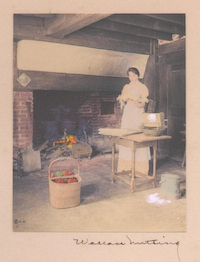
Old Deerfield, few remember what these museum towns actually mean. The range of artistic and social movements associated with such places over the years give one an idea of the various facets of human interest they appealed to: preservationism, the Colonial revival, Arts and Crafts, historical pageantry and so on. At one time the opinions and designs of John Ruskin and William Morris or, later, the writings and the photographs of reached broad popular audiences through a variety of books and magazines. A housewife would not think of decorating her home without consulting them, or even paying a visit to a place like Deerfield, where she might even expect to purchase examples of traditional crafts from local artisans, as well as photographic records of the exhibits or reenactments she had seen on the spot. These she could take home for inspiration, either for practical decorative ends or simply to recreate the mood of times gone by.
|
|
|
|
Paul Taylor, Themes and Variations, and Susan kae Grant, Night Journey
at The Hallmark Museum of Contemporary Photography, 85 Avenue A,Turners Falls, MA 01376
; . Open Thursday through Sunday, 1 p. m. to 5 p. m.; Closes March 16, 2008. Admission free.
|
|
Michael Miller
|
February 5, 2008
|
|
has expanded. It now boasts two state-of-the-art galleries, each in separate buildings, which it is now using to host two one-person shows, one a retrospective of impressive photographic work, and the other a specific project by Texas photographer . Both exhibitions were inaugurated by slide lectures by the artists, making for a full and extremely stimulating evening. These were held at the equally impressive , which specializes in commercial photography and the business of photography, but, as this evening showed, it provides students with a constant flow of inspiration from the very best fine art photography. The present exhibitions are particularly sophisticated examples of this. As Paul Turnbull, the executive director and curator of the HMCP, pointedly asked the students at several points in the evening, âAre you making photographs, or are you taking pictures?â hence the lectures contained more technical considerations than those addressed to the general public. All the better.
|
|
|
Paul Taylor, photographs of Cappadocia and the Connecticut River
, Brattleboro, Vermont, Nov. 2- 28, 2007
Slideshow of Selections from the Exhibition
Web:
E-mail:
|
|
Michael Miller
|
November 24, 2007
|
|
The awareness of works of art as objects has not fared well among art historians in recent years, but Iâd like to think that it shows signs of life in the world of galleries and collecting, and occasionally in museums. Any admirer or buyer of Chris Ofili must appreciate the material differences between metallic lamé and elephant dung, just as only the most uneducated beginning collector of photography must be unaware of the commercial if not the aesthetic qualities of a vintage print. Fine art photographers, especially today, in the early years of digital photography, are keenly experimenting with new papers and inks in their efforts to make their images come alive as objects. Whatâs more, gelatine silver, die transfer, platinum/palladium, and carbro, to name only a few, are all actively pursued in their respective niches, large or small. Now that inkjet printing has become the workhorse of the photographic industry, in fact, gelatine sliver printers should enjoy a certain sense of liberation. Paul Taylor, whose magnificent exhibition is about to close at the Catherine Dianich Gallery in Brattleboro, is a telling example.
|
|
|
|
|
|
November 14, 2007
|

|
|
|
|
|
Rebecca Lepkoff, Eliza Peoria "Ma" Smith with Her Cat, 1950.
|
|
|
| |
| Search The Berkshire Review for the Arts |
|
|
| |
|
|
|
|
|
|
|
|