The story that Harper Lee tells in To Kill a Mockingbird has been in the mind of the American public since the novel was published in the summer of 1960. Itâs the fictional story of a black man wrongfully accused of rape in Maycomb, Alabama, in 1935, toward the end of Rooseveltâs first term. Tom Robinson, the accused, is being defended by Maycombâs most respected white attorney, Atticus Finch. The character Finch is still regarded by many in the law profession as a hero and a model.Â
Cooling comments to Finch and his family about befriending a black man, the sheriff tells him: âThereâs nothing to fear but fear itself.â For blacks, there was, day after day, a great deal to be afraid of in 1935. And not much had changed by 1960 but that summer, when the book came out, there were signs that segregation was beginning to be chipped away by Southern blacks.Â
In the spring, for example, the Student Nonviolent Coordinating Committee (SNCC) under Stokely Carmichael was organized and students in Greensboro were leading sit-ins at lunch counters at Woolworthâs.
The novel contains these murmurings, but its most pointed reference, not spelled out, is the Emmett Till murder in Money, Mississippi in 1955âinvolving a fourteen-year-old boy visiting from Chicago who was murdered by whites for looking too long at a white woman in a corner store.Â
Â
It is these parallels when looking at the playâseeing the characters up close againâthat brings back painful images of the struggle for racial integration. I wasnât sure if the young people who attended the Sunday matinee understood much about the history of civil rights in the Southâas their grandparents might have. It looked to me as if a few grandparents had moved their memory into a self-congratulatory mode, recalling their own efforts to fight the injustices, if I heard the comments in the lobby and the audience correctly. But that may have been a nod to where we are in 2008, almost fifty years laterâon the eve of possibly electing the first African American (bi-racial) President of the country.
To Kill a Mockingbird, which won the Pulitzer Prize, has sold over five million copies, and ranks on top ten lists of best loved books. Perhaps in todayâs climate, it is not surprising that since the mid-1990s according to the American Library Association, the novel is also on many banned booklists around the country for reasons of rough language and unfair depiction of raceâat the request of both whites and blacks.
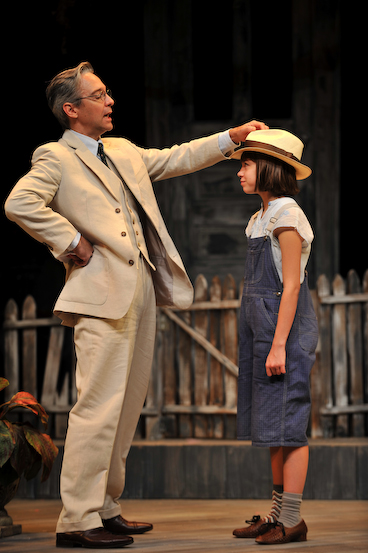
Barrington Stage as part of Pittsfieldâs citywide Big Read project does a creditable job. Kids (10 and up) will enjoy seeing the story unfold through the eyes of Atticusâ children, Scout and Jem, and their friend Dill. The players, all with impressive credentials, find their wayâMiss Maudie (Debra Jo Rupp), the Sheriff (Bob Sorenson) and the Judge (Bob Lohbauer) do a good job to keep the story movingâbut all the players are hampered by the construction and condensation of the playâs script.Â
The play was adapted from the novel by Christopher Sergel in 2000. Itâs too bad that Horton Foote who wrote the screenplay for the movie did not write this script. The playwright included most of the characters from the book (15), some for very brief appearances. There is little indication of time passing which in the book is three years, leaving the children, in particular, stuck at the age they are introduced. The stage is sometimes too overworked and too small to clearly define each neighborâs turf and too unfocused as a set to allow the events of the drama, particularly the trial and the Boo Radley story to play out with full tension. The most successful scene is the kidsâ appeal to the mob outside the jail to disperse and give up their intention to harm Tom Robinson.Â
Aside from the necessary shortcuts, the production has much value as a dramaÂ
âfine serious and comedic momentsâfor families and for discussions of our history.
Â
Barrington Stage Company, 30 Union Street, Pittsfield â
Wednesday, Thursday â 7pm; Friday, Saturday â 8 pm; Saturday, 4pm;
Sunday, 3pm.
For links to the various ancillary programs,
Deborah Brown
|

 '
'