
The Kirov Ballet in London

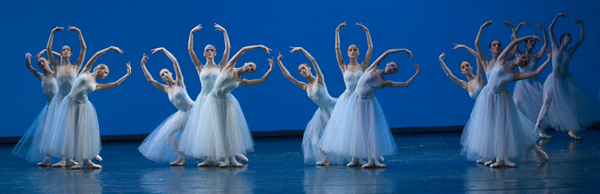
The Kirov Ballet in Balanchine's "Serenade"
The Sleeping Beauty
Music by Pyotr Ilyich Tchaikovsky
Choreography by Marius Petipa, revised by Konstantin Sergeyev
Homage to Balanchine
Serenade, "Rubies" from Jewels, Symphony in C
To its real purists, classical ballet is like the ancien regime to royalists—the woman next to me, who had flown to London from San Francisco, adored the majestic Kirov Ballet unreservedly, unless they did Balanchine. She wanted the old standbys again and again, a perpetual merry-go-round of dance in the nineteenth century. At nearly $175 a ticket, she was attending all three performances of The Sleeping Beauty, including two in one day, and could detail differences in the styles of second-tier ballerinas in the company, never mind the stars. I felt abashed. But after seeing one Sleeping Beauty and a three-part program entitled Homage to Balanchine, I came away feeling closer to the Kirov, which is like feeling closer to Versailles. (One is now supposed to say Mariinsky Ballet. Since the name Kirov refers to a Soviet bureaucrat, the company has been steadily renaming its various parts Mariinsky, after their theatre. Only the Kirov Orchestra, under the great Valery Gergiev, has yet to revert to the old name, so far as I know.)
I have no right to make supposedly acute observations about how the Mariinsky is doing at present. They successfully made the transition from their Soviet incarnation intact, and to my eye, having seen them several times since glasnost, one glory follows another. A look at the documentary Ballerina (2009), which features five Mariinsky dancers, including the reigning star, Diana Vishneva (who gave me the personal sense of superhuman ability), is enough to show where the company gets its hallmarks: disciplined refinement, absolute integrity, reverence for tradition, and nobility. Those qualities won't get you very far in a boogie-woogie, however, as was apparent in the "Rubies" movement from Balanchine's Jewels. Mr. B. was an omnivore of dance styles, which he morphed into classical variations. Here he has Stravinsky's jazzy Capriccio for piano and orchestra to work with, and the leading couple, dressed in quasi-Las Vegas scarlet outfits replete with fringe and spangles, should have a touch of jazz baby and hoochie-koochie in them. Irina Golub and Vladimir Shklyarov are hot young properties, both looking barely post-adolescent and ready to rock, but their Kirov training muzzles them a little -- they can't quite bring themselves to lose their dignity while maintaining it, the trick that Balanchine inspired in his own dancers.
More successful was Serenade, which is set to Tchaikovsky's sweet, lusciously rich Serenade for Strings. Here Balanchine echoed the weight of a full string body with a crops of dancers who move with their own weight and purity. The Russians felt at home, and the final Adagio was a study in grave beauty (the ballet is abstract, but there's an implication that two girls are looking for love, and one languishes while the other rises). The triumph of the evening, however, was Balanchine's glorious signature work, Symphony in C, set to Bizet, which calls upon the entire company, up to sixty dancers in the tumultuous finale. The Mariinsky company must be unique in their depth, and here they fielded four superb couples and multiple echelons of corps dancers. I watched transfixed at the motionless pose of ten girls on either side, who at one point had to hold identical positions for several minutes before being allowed to shift their feet—they could get work as the definition of identical.
Sleeping Beauty isn't charged with drama; much of the action moves at the pace of a processional. But it features two-and-a-half hours of textbook Petipa, displaying the full repertoire of romantic choreography. Tchaikovsky's score is itself a masterpiece—I heard Gergiev and the London Symphony perform it at a Proms last summer without dancers. On tour the Mariinsky leave nothing at home. At my matinee we had not only the lavish scenery and lightning effects but a real fountain spouting fifteen feet high for the finale. Vladimir Shklyarov reappeared as a very boyish Prince but armed with quick, high leaps and rounds that earned cheers. Princess Aurora was the girlish Anastasia Kolegova, who is not as experienced as some of the other prima ballerinas, according to someone in the know sitting behind me. It showed a bit in the Rose Adagio, where her face tensed up visibly during the trickiest moments of balancing en pointe as each suitor turned her around and then released her hand. But she was vivacious and wanted the audience to like her, two qualities that went a long way. The enormous ensemble of soloists and corps were, as expected, perfect. A note should also be made of the orchestra, which plays with Russian passion and no laziness. Pavel Bubelnikov, a veteran conductor with the company, displayed real musicality and vigor throughout, no mean thing when you consider that he has probably performed Sleeping Beauty about as many times as you and I have brushed our teeth.
My untutored comments go a ways toward describing the acknowledged supremacy of the Mariinsky company in classical repertoire, as well as their rising ability in some modern pieces—they are very intent on reclaiming Balanchine, who graduated from the Mariinsky school before he fled west. A New York dance critic was on the premises, and she voiced her dislike of the Russian way with Balanchine. Admittedly, it's a bit like hearing Sviatoslav Richter attempt Rhapsody in Blue, but would you turn down the chance to be there? It's persnickety to hold these young Mariinsky dancers to the standards of the New York City Ballet, and stupidly snobbish to call their style wrong, as this critic did. There's more than one kind of right, since style must be allowed to shift with the generations. As a museum of the nineteenth century, the Mariinsky owns its identity, but with Balanchine it looks to its growth.
Leave a Response

 Entries(RSS)